
How Jackpot Meters Work in Online Slots: A Simple Guide
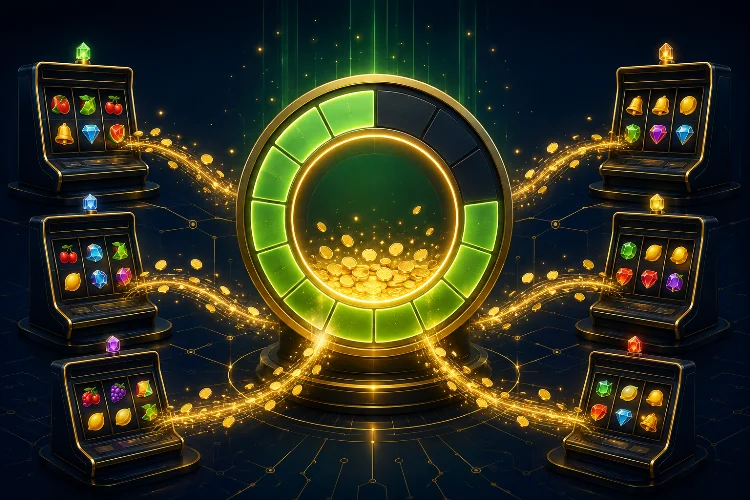
A jackpot counter climbing from £10,000 to £10,001, then £10,002 can make an online slot feel as though something important is happening every second. The number is highly visible, often animated, and deliberately easy to notice. But what exactly is happening behind that changing figure?
Understanding How Jackpot Meters Work is easier once you separate the displayed number from the system controlling the prize. In progressive games, a jackpot normally starts from a predetermined base value and can increase as qualifying wagers contribute money to the prize pool.
The UK Gambling Commission defines a progressive jackpot as an incremental prize that grows from a preset base value through contributions from money staked in a game.
The meter simply gives players a window into that changing prize.
What Is a Jackpot Meter?
A jackpot meter is the displayed value showing the current size of a jackpot prize. You might see it above the reels, inside a bonus panel, or beside labels such as Grand, Major, Minor, or Mini.
Not every meter works the same way. Some belong to one individual game, while others may represent a progressive jackpot shared between many games or participating players.
The important point is that the meter is not usually a countdown. A rising total does not automatically mean the jackpot is becoming more likely to hit unless the specific rules say that probability changes.
Regulated progressive systems are expected to explain how their jackpots work. UK Gambling Commission guidance says jackpot rules should describe funding, the start-up seed, ceiling values where applicable, and how prizes are determined.
The Jackpot Usually Starts With a Seed Value
Progressive jackpots generally do not begin at zero.
Instead, they start from a base or seed amount. Imagine a fictional jackpot that resets to £5,000 after being won. That £5,000 is its starting point.
From there, qualifying game activity may gradually push the total higher. The displayed meter could show £5,120, £5,800, or considerably more depending on how much qualifying play has taken place.
When someone eventually wins, the visible jackpot usually returns to its designated reset level or another value defined by the game rules. UK technical guidance specifically requires participating customers to be informed of the jackpot’s reset value after it is triggered.
That reset can look dramatic, but it is a normal part of progressive jackpot operation.
How Player Contributions Increase the Meter
The growing part of the jackpot generally comes from a contribution mechanism.
Suppose a fictional slot directs a small portion of qualifying wagers toward its progressive pool. If enough wagers occur across participating games, those small contributions accumulate and the jackpot meter continues rising.
This does not mean the entire wager goes into the jackpot. The actual contribution formula depends on the game’s mathematical configuration and rules.
UK Gambling Commission requirements state that jackpot information should explain how the progressive prize is funded. They also note that where customers contribute to the pool, eligibility and the relationship between contributions and chances of winning should be handled fairly.
The exact percentage can therefore vary from one progressive system to another.
Why Some Meters Move Faster
A jackpot linked to a large number of active games can potentially collect qualifying contributions faster than one receiving relatively little play.
That is why two jackpots with similar starting values may grow at noticeably different speeds.
Gaming Laboratories International recognises multiple progressive configurations, including stand-alone, linked, multi-site, and random systems. Its current standards catalogue includes GLI-12 specifically for progressive jackpot systems.
So a quickly moving meter does not necessarily indicate that one individual player is wagering heavily. It can reflect activity occurring across a much larger progressive network.
Local and Network Jackpots Work Differently
One useful way to understand jackpot meters is to look at the size of the network behind them.
A stand-alone progressive may be attached to a single gaming implementation. A linked system connects multiple eligible games, while larger multi-site or wide-area systems can pool activity across a broader group.
Gaming Laboratories International’s technical material identifies stand-alone, linked, multi-site, and random progressive configurations, while commercial gaming suppliers also operate wide-area progressive products.
The underlying principle remains similar: a central system tracks the progressive value and keeps participating displays synchronised as accurately as practical.
This is why a jackpot total can change while you are simply watching the game without spinning. Other eligible activity may be contributing to the same pool.
Does the Meter Decide When the Jackpot Hits?
Usually, you should not assume that the displayed meter itself determines the winning moment.
Depending on the game design, a jackpot might require a particular reel outcome, a bonus event, a mystery trigger, or another clearly defined condition. The rules should explain what actually awards the prize. UK regulations specifically require information about jackpot contributions and whether the prize depends on achieving a particular outcome.
Where random outcomes are involved, regulated systems must produce results that meet applicable randomness requirements. UK technical standards require RNG-driven outcomes to be acceptably random and unpredictable according to the game’s theoretical probabilities.
This distinction is important. Seeing a very large meter does not automatically tell you that the next spin has a better chance.
That is one of the most common jackpot misunderstandngs.
What Happens When Somebody Wins?
When an eligible player triggers the jackpot, the system records the award and the progressive amount is reset according to its rules.
Other players connected to the same jackpot may see the displayed figure change soon afterwards. Network latency means screens are not always updated at precisely the same millisecond, which is one reason technical rules need procedures for apparently simultaneous wins.
The UK Gambling Commission requires jackpot rules to explain how prizes are handled when two or more players trigger, or appear to trigger, the same jackpot at the same time. Current values should also be refreshed as frequently as practicable.
Behind the simple animation is therefore a much more compelx accounting and communication system.
Jackpot Size and RTP Are Not the Same Thing
Another common mistake is assuming that a larger jackpot automatically makes a slot more generous.
Return to Player, or RTP, describes the theoretical proportion of stakes returned across very large volumes of play under the game’s mathematical model. A progressive jackpot can form a separate component of that calculation.
UK Gambling Commission monitoring guidance recommends evaluating progressive jackpot activity separately from the base game because jackpots can be extremely large, infrequent, and volatile.
So a jackpot meter at £1 million does not mean the base game’s normal payouts suddenly become better.
It simply tells you the present jackpot amount.
Why Jackpot Meters Feel So Compelling
From a design perspective, the meter turns an invisible mathematical pool into something players can see changing.
A static jackpot saying £10,000 feels different from one visibly climbing through £10,137.22. Even tiny movements create the impression of continuous activity.
That does not change the underlying odds unless the published rules explicitly define a probability mechanism linked to the jackpot value.
Players should therefore treat the display as information rather than a prediction tool. The meter tells you what the jackpot may currently be worth, not when the next winning occurence will arrive.
Checking the game’s rules is more useful than trying to interpret how quickly the numbers move.
Understanding How Jackpot Meters Work makes progressive slots much easier to read. The meter normally reflects a prize that begins at a seed value and grows through qualifying contributions before resetting after a win. It does not automatically predict when the jackpot will hit.
Before playing, check the game’s rules, eligibility requirements, RTP information, and jackpot conditions rather than relying on the visable total alone.