
Wireless Earbuds Compared by Audio Codec Support and Sound Quality
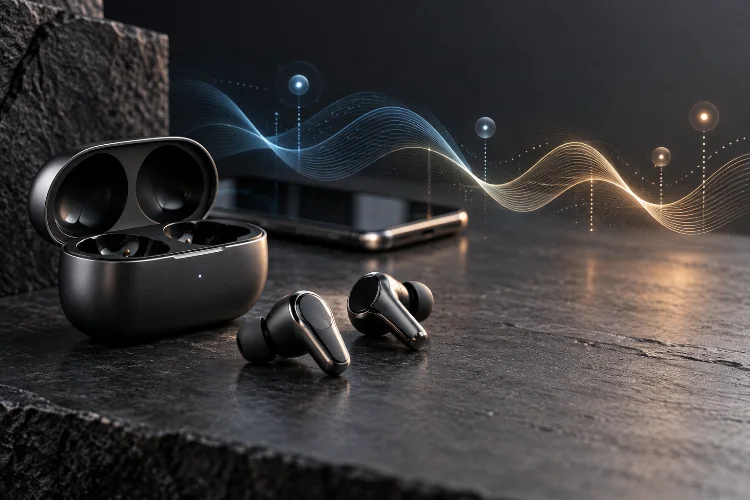
Buying premium wireless earbuds can quickly turn into an alphabet soup. One model supports LDAC, another advertises aptX Lossless, Samsung talks about SSC-UHQ, and newer earbuds increasingly include LC3 and Bluetooth LE Audio.
It sounds like choosing the best codec should automatically give you the best sound. In reality, things are not that simple.
When wireless earbuds are compared by audio codec support and sound quality, the codec is only one piece of the audio chain.
Driver quality, frequency tuning, distortion, ear-tip seal, DSP processing, ANC behavior, and even your smartphone can have afn equal – or sometimes greater – impact on what reaches your ears.
A theoretically superior codec is also useless if your phone cannot transmit it. For example, aptX Lossless requires compatible source hardware, while Samsung’s highest-quality codec features work most naturally inside the Galaxy ecosystem.
So, instead of simply chasing the highest bitrate, let’s look at how today’s major codec options work and how popular premium earbuds actually compare.
Why Bluetooth Audio Codecs Matter
Bluetooth audio cannot normally send raw studio-quality audio using unlimited bandwidth. The source device first encodes the audio, transmits it wirelessly, and the earbuds decode it again.
A codec determines how that compression happens.
SBC is the basic codec supported broadly across traditional Bluetooth audio devices. AAC is another common option and is particularly important for Apple devices, while Android manufacturers increasingly support higher-end alternatives.
The biggest benefit of a better codec is generally the ability to preserve more information or deliver similar quality more efficiently.
But bitrate alone should never be treated as a sound-quality score.
A pair of earbuds with excellent frequency tuning and AAC can easily sound more natural than poorly tuned earbuds receiving a much higher bitrate stream. The codec determines transmission quality; it does not redesign the drivers or correct bad acoustic engineering.
SBC and AAC: Basic Does Not Mean Bad
SBC has a reputation for being the “cheap” Bluetooth codec, mainly because almost everything supports it.
However, SBC can still sound perfectly acceptable for everyday music, podcasts, YouTube, and casual streaming. Its biggest advantage is compatiblity: if two conventional Bluetooth audio devices can connect, SBC usually provides a common fallback.
AAC is another important option.
Most mainstream premium earbuds support AAC, including models from Sony, Samsung, and Sennheiser. It is particularly useful when connecting earbuds to an iPhone because Apple relies heavily on AAC for Bluetooth music playback.
For Spotify streaming during a commute, the difference between AAC and a high-bitrate codec may also be less dramatic than specification sheets suggest.
Background noise, ANC, ear-tip fit, and the mastering quality of the song can easily become bigger factors.
This is why codec support should be viewed as part of the complete product rather than as a simple ranking system.
Sony WF-1000XM6: LDAC for High-Resolution Android Audio
Sony’s WF-1000XM6 is a good example of an Android-friendly premium earbud built around LDAC.
Sony confirms that the WF-1000XM6 supports LDAC for high-resolution wireless playback when connected to a compatible device and configured for sound-quality priority.
LDAC is especially popular among Android enthusiasts because it can transmit substantially more data than basic Bluetooth codec configurations when conditions allow.
The catch is wireless stability.
Higher-quality Bluetooth transmission needs a reliable connection, and Sony itself notes that radio interference can affect Bluetooth performance in crowded environments. Its Sound Connect software therefore lets users prioritize either audio quality or connection stability.
Sound quality also depends on Sony’s acoustic tuning rather than LDAC alone. SoundGuys’ laboratory testing found the WF-1000XM6 generally offers a crowd-pleasing sound signature, although enabling ANC can change bass behavior somewhat.
For Android users who want flexible EQ, strong ANC, and LDAC support, Sony remains a compelling option.
Sennheiser Momentum True Wireless 4: The Codec Enthusiast’s Choice
The Sennheiser Momentum True Wireless 4 has one of the broadest codec selections among premium earbuds.
It supports SBC, AAC, standard aptX, aptX Adaptive/Lossless, and LC3. Sennheiser also provides separate high-resolution, lossless, standard, and low-latency modes through its software.
Its aptX Lossless support is particularly interesting.
With compatible Snapdragon Sound hardware, Sennheiser says the earbuds can provide bit-accurate 16-bit/44.1kHz CD-quality transmission. The source phone must support the feature as well, so simply buying the earbuds does not automatically activate lossless Bluetooth.
Qualcomm describes aptX Lossless as part of Snapdragon Sound, with transmission capable of scaling according to wireless conditions rather than stubbornly maintaining maximum data rates when interference becomes severe.
More importantly, the earbuds also sound good independently of their codec list.
SoundGuys measured an overall MDAQS audio-quality score of 4.8/5, with particularly strong timbre performance.
For listeners who care about codec flexibility and tuning, the Momentum True Wireless 4 remains one of the strongest all-around choices.
Samsung Galaxy Buds4 Pro: Best Inside the Galaxy Ecosystem
Samsung takes a more ecosystem-focused approach with the Galaxy Buds4 Pro.
The earbuds support SBC, AAC, LC3, Samsung Seamless Codec, and SSC-UHQ. Samsung lists SSC-UHQ support at up to 24-bit/96kHz on compatible Galaxy hardware.
That is important because proprietary codecs create both advantages and limitations.
If you already use a compatible Samsung Galaxy phone, SSC-UHQ can provide a more integrated high-quality audio path.
Pair the same earbuds with another manufacturer’s phone, however, and you may fall back to more universal codecs such as AAC, SBC, or LC3 depending on device support.
The Buds4 Pro also uses an enhanced two-way speaker arrangement with separate dynamic woofer and tweeter elements, according to Samsung.
That hardware matters just as much as the codec.
SoundGuys gave the Galaxy Buds4 Pro a 4.8/5 multidimensional audio-quality score in its lab testing, with a particularly strong timbre result.
So while SSC-UHQ is a useful feature, the real reason to consider Samsung’s flagship earbuds is the combination of codec integration, driver design, DSP, and Galaxy-specific features.
LC3 and LE Audio Could Matter More Than Huge Bitrates
One of the most interesting developments in wireless earbuds is not another ultra-high-bitrate codec.
It is LC3.
LC3 is the mandatory audio codec introduced with Bluetooth LE Audio. The Bluetooth SIG says LC3 can provide higher quality than SBC at the same bitrate—or comparable quality while operating at substantially lower data rates.
That efficiency can translate into several benefits.
Manufacturers can potentially improve battery life, reduce radio airtime, or allocate processing resources toward other features. LE Audio also supports technologies such as Multi-Stream Audio and Auracast.
This is why newer devices increasingly list LC3 even when they already support premium proprietary codecs.
Samsung’s Galaxy Buds4 Pro includes LC3, while the Sennheiser Momentum True Wireless 4 supports it alongside aptX.
Instead of focusing purely on ever-higher bitrates, LC3 aims for better effeciency.
For everyday true-wireless earbuds, that may ultimately be more valuable.
Why Better Codecs Do Not Guarantee Better Sound
This is the most important point when comparing earbuds.
An audio codec only controls one stage of the signal path.
Once the data reaches the earbuds, digital signal processing, amplifiers, drivers, acoustic chambers, ear tips, and your actual ear shape all influence the final result.
Fit alone can completely change bass response.
If an earbud does not seal properly, low-frequency energy can escape. Suddenly an expensive lossless codec is transmitting an incredibly accurate signal to earbuds that sound thin because the tips do not fit your ears.
Frequency tuning also matters.
SoundGuys’ comparison of the Sennheiser Momentum True Wireless 4 and Sony WF-1000XM5 found both products performed strongly despite relying on different premium codec strategies. The Sennheiser supports aptX Adaptive, while Sony relies on LDAC.
This illustrates why “LDAC vs aptX” is rarely enough to determine which product will sound better.
Your sound preferance matters too. Some listeners enjoy extra bass, while others prioritize neutral mids, vocal clarity, or treble detail.
Match the Earbuds to Your Smartphone First
Codec compatibility should be checked from both sides of the connection.
Buying aptX Lossless earbuds makes little sense if your phone cannot transmit aptX Lossless. The same applies to LDAC, Samsung SSC-UHQ, and advanced LE Audio features.
Sennheiser specifically requires a compatible Snapdragon Sound source for its lossless mode. Samsung’s premium SSC-UHQ experience, meanwhile, is designed around supported Galaxy devices.
Sony’s LDAC has relatively broad Android support, making it a convenient option across multiple Android brands.
iPhone users should pay particular attention here. AAC performance and the earbuds’ own tuning may matter more than paying extra for Android-focused codecs that an iPhone will not use.
Before buying, therefore, check your phone’s supported Bluetooth codecs first.
That simple step can prevent paying for impressive specifications that remain completely unused.
Comparing wireless earbuds by audio codec support is useful, but codecs should never be treated as the final measure of sound quality.
Sony’s WF-1000XM6 is particularly attractive for Android users who want LDAC, while the Sennheiser Momentum True Wireless 4 offers exceptional codec variety with aptX Adaptive/Lossless and LC3.
Samsung’s Galaxy Buds4 Pro makes the most sense inside the Galaxy ecosystem thanks to SSC-UHQ, while LC3 and LE Audio point toward a more efficient future for wireless sound.
Still, driver quality, tuning, fit, DSP, and source compatibility remain just as important.
Before buying your next earbuds, check which codecs your phone actually supports, then compare objective sound measurements and comfort. The best codec is useful – but the best-sounding earbuds are the ones that get the entire audio chain right.