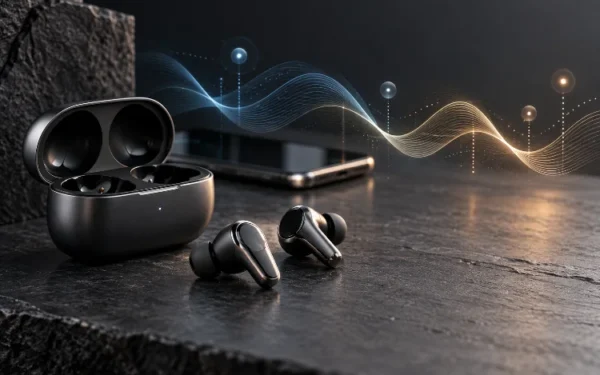
How Wireless Earbud Drivers Shape Bass and Vocal Clarity
Two pairs of wireless earbuds can cost the same, support the same Bluetooth codec, and even use similar noise cancellation, yet sound completely different. One might deliver deep, punchy bass while another makes vocals feel clearer and more forward.
A big part of that difference comes from the driver system.
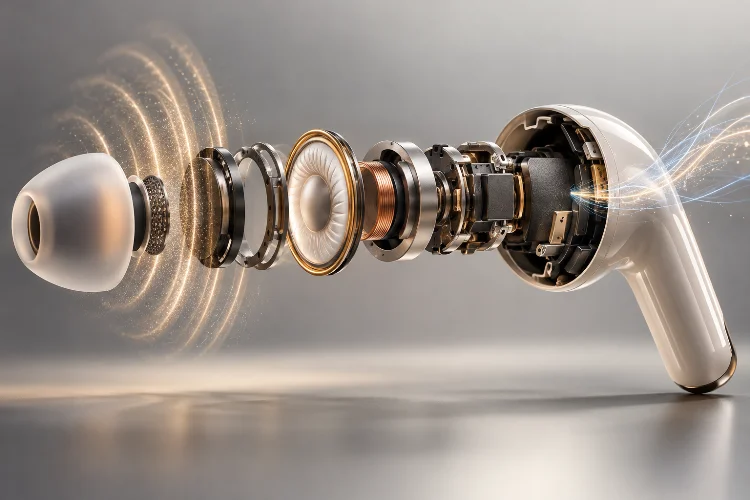
Wireless earbud drivers are tiny transducers that convert electrical signals into the physical movement that creates sound. Their size, diaphragm material, magnetic system, acoustic chamber, and tuning all influence what you eventually hear.
But there is no simple rule saying a larger driver automatically means better bass or that multiple drivers always produce better sound.
Modern earbuds use everything from traditional dynamic drivers to balanced armature tweeters, two-way systems, and newer designs such as magnetic-fluid drivers.
Software equalization and digital signal processing also shape the final result.
Understanding how these technologies work makes it easier to separate useful audio engineering from impressive-looking specifications when shopping for your next earbuds.
Dynamic Drivers Are Popular for a Good Reason
Dynamic drivers are the most common design in wireless earbuds.
They operate using a diaphragm attached to a voice coil placed inside a magnetic field. When an electrical audio signal moves through the coil, the diaphragm moves back and forth, pushing air and creating sound.
This relatively simple design can reproduce a broad frequency range from a single driver.
Dynamic drivers are particularly well suited to bass because they can move a meaningful amount of air. That does not mean every dynamic earbud is bass-heavy, however. Bass quantity depends heavily on diaphragm movement, enclosure design, venting, DSP, and tuning.
Sennheiser’s Momentum True Wireless 4 is a good example. It uses a single 7mm TrueResponse dynamic driver rather than a complicated multi-driver system. Sennheiser says its tuning was refined to improve treble and midrange clarity while maintaining immersive bass.
That demonstrates an important point: one well-engineered driver can cover the entire spectrum effectively.
More drivers are not automatically better.
Driver Size Can Influence Bass, but It Is Not Everything
Earbud manufacturers often advertise driver diameter because it is easy to understand.
A 10mm driver sounds more impressive than a 6mm driver, but diameter alone tells you surprisingly little about actual sound quality.
A larger diaphragm can potentially move more air and produce strong low-frequency output with less excursion. However, the diaphragm’s material, stiffness, weight, magnetic force, suspension, and acoustic enclosure all influence what happens in practice.
Technics demonstrates this with the EAH-AZ100, which uses a 10mm Magnetic Fluid Driver. The design places magnetic fluid around the voice coil to help control movement and reduce unwanted vibration.
Technics pairs that system with an ultra-thin free edge and aluminum diaphragm, targeting deep bass with low distortion alongside detailed mid and high frequencies.
So rather than asking, “How big is the driver?” a better question is, “How well is that driver controlled?”
A smaller, lighter diaphragm with excellent engineering can easily outperform a larger but poorly designed unit.
Balanced Armature Drivers Focus on Speed and Detail
Balanced armature, or BA, drivers use a very different mechanism.
Instead of moving a traditional cone or dome with a voice coil, a tiny armature moves inside a magnetic field and transfers its movement to a diaphragm.
The design can be extremely compact and responsive.
Knowles, one of the major manufacturers of balanced armature technology, describes BA drivers as lightweight transducers capable of high output and detailed response. They can also be optimized as woofers, tweeters, or full-range units depending on their design.
Their compact size is particularly useful inside earbuds, where every millimeter matters.
Balanced armatures are frequently used for upper-frequency reproduction because their low moving mass can help produce precise transient detail.
That can make vocal harmonics, strings, cymbals, and other fine elements sound crisp.
However, a BA driver does not automatically mean better vocal reproduction. Poor crossover design or aggressive tuning can still make voices sound unnatural or overly bright.
Implementation remains more important than the technology label.
Hybrid Driver Systems Split the Work
If one driver has different strengths from another, why not use both?
That is the idea behind hybrid and multi-driver earbuds.
A common configuration uses a dynamic driver for bass and lower midrange frequencies while a smaller tweeter or balanced armature handles the upper spectrum.
Sony has used this concept in its hybrid in-ear designs. Its XBA-N3 combines a 9mm dynamic driver for low and mid frequencies with a balanced armature unit intended to extend high-frequency reproduction.
Sony describes the dynamic component as providing deep bass and clear mids while the BA driver handles higher-frequency detail.
Modern true-wireless products use similar principles.
Samsung’s Galaxy Buds4 Pro features an advanced two-way system combining a wider dynamic woofer with a separate tweeter. Samsung says the woofer has an expanded diaphragm area, while the tweeter handles higher frequencies independently.
Separating the workload can reduce the need for one tiny driver to reproduce everything from sub-bass to upper treble.
The challenge is making those drivers behave like one coherent speaker.
Crossovers and Tuning Determine Whether Multiple Drivers Work
Adding more drivers creates another engineering problem: deciding which frequencies each driver should reproduce.
That requires crossover design and careful tuning.
Imagine a woofer operating strongly up to the upper midrange while a tweeter begins reproducing the same frequencies too early. Their outputs could overlap in ways that make certain notes louder than intended.
The opposite problem can happen too.
If the woofer stops reproducing frequencies before the tweeter properly takes over, there may be a dip in the response.
Well-designed multi-driver earbuds try to make the transition seamless.
Samsung pairs the two drivers in the Galaxy Buds4 Pro with dedicated amplification, allowing the woofer and tweeter to be controlled separately. Samsung says this approach provides more precise control with reduced interference between the two speaker sections.
This is why simply counting drivers is a poor way to judge sound quality.
A carefully tuned single dynamic driver can sound much more natural than a poorly integrated triple-driver system.
Bass Quality Is About Control, Not Just Quantity
When people say an earbud has “good bass,” they can mean several different things.
Some listeners want huge sub-bass that makes electronic music physically exciting. Others prefer tight bass that stops quickly and does not cover vocals.
Driver control strongly affects this difference.
If the diaphragm continues moving after a bass note should have ended, low frequencies can sound loose or muddy. Excessive mid-bass can also bleed into the lower midrange and make male vocals or guitars sound thick.
Technics designed its magnetic-fluid system partly to reduce unwanted vibration and distortion. The company says the AZ100’s acoustic chamber is also designed to balance natural midrange reproduction with powerful bass.
A good bass driver therefore needs more than raw output.
It should deliver extension, impact, and texture while stopping quickly enough to preserve seperation between instruments.
That is especially important in dense recordings where bass guitars, drums, synthesizers, and vocals occupy nearby frequency regions.
Vocal Clarity Depends Heavily on the Midrange
Drivers matter for vocals, but clear voices are not simply produced by adding a tweeter.
Most of the fundamental energy of human voices sits in the midrange, while upper harmonics contribute presence, intelligibility, and detail.
If an earbud boosts bass excessively, vocals can sound distant. Too much upper-midrange energy can make singers feel unnaturally aggressive, while excessive treble may exaggerate “S” sounds.
Sennheiser’s approach with the Momentum True Wireless 4 is interesting because it uses one dynamic driver but specifically tunes its frequency response for clearer mids and refined treble.
Samsung instead splits parts of the frequency range across a woofer and tweeter.
Neither architecture guarantees superior vocals.
What matters is the final frequency response, distortion behavior, transient response, and how smoothly different parts of the spectrum connect.
This is why listening impressions and frequency-response measurements are often more usefull than the driver specification alone.
Ear-Tip Fit Can Change Bass More Than the Driver
Even the world’s best driver cannot produce proper bass if the earbud does not seal correctly.
Low-frequency sound easily escapes through gaps between the ear tip and ear canal. A weak seal can make an earbud sound thin, bright, and almost completely different from its intended tuning.
Push the same earbud slightly deeper or install a correctly sized tip, and the bass may suddenly return.
This can also change your perception of vocals.
When missing bass is restored, the entire tonal balance shifts. Conversely, an unusually strong seal can sometimes make an already bass-heavy tuning feel excessive.
Ear anatomy varies significantly, which is one reason two people can disagree strongly about the same earbuds.
Before deciding that a particular driver lacks bass, test different ear-tip sizes and make sure both ears have a secure seal.
The driver creates the acoustic energy, but the fit determines how much of it reaches your eardrum as intended.
DSP Means the Driver Is Only Part of the Story
Modern wireless earbuds are miniature computers as much as they are speakers.
Digital signal processing can modify frequency response, compensate for driver characteristics, control bass at different volumes, adapt sound according to fit, and change tuning when ANC is enabled.
This gives manufacturers enormous flexibility.
A dynamic driver that naturally has slightly uneven response can be electronically corrected. Multi-driver systems can also use DSP to manage their frequency balance.
User EQ adds another layer.
Sennheiser, for example, offers EQ controls, presets, Bass Boost, and personalized sound options around its 7mm dynamic-driver platform.
Consequently, judging earbuds only by driver material or diameter misses a large part of modern audio engineering.
The physical driver still establishes important limits for distortion, excursion, and frequency extension, but software strongly influences the final sound arriving at your ears.
Wireless earbud drivers have a major influence on bass response, vocal clarity, detail, and distortion, but no single driver technology guarantees the best sound.
Dynamic drivers remain excellent for full-range reproduction and powerful bass. Balanced armatures can add compact, fast high-frequency reproduction, while hybrid and two-way designs allow different drivers to specialize in different parts of the spectrum.
Technologies such as Technics’ magnetic-fluid system show that even the traditional dynamic driver continues to evolve.
Still, driver size and quantity should never be your only buying criteria.
Frequency tuning, crossover integration, DSP, acoustic chambers, distortion, and ear-tip fit can change the listening experience just as dramatically.
Before buying premium earbuds, check measurements and reviews alongside the driver specifications – and remember that the best design is the one that makes your favorite music sound natural to you.