Mobile Gaming Beyond Raw Processor Speed: What Makes a Phone Great?

A flagship processor sounds like the obvious starting point when shopping for a gaming phone. After all, faster hardware should mean faster games. In reality, processor speed is only one piece of a much larger puzzle.
A smartphone can dominate short benchmark tests and still become frustrating after half an hour if it gets too hot, drops frames, drains its battery quickly, or has a display that cannot take advantage of its graphics performance.
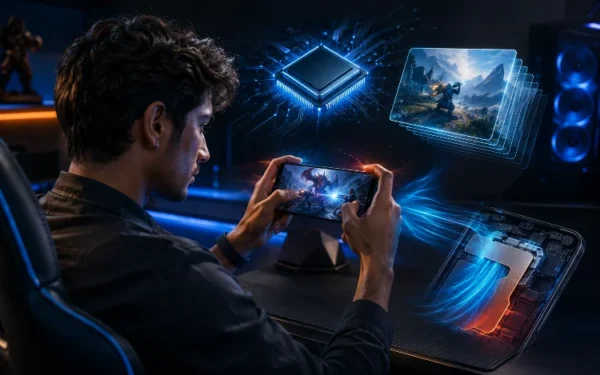
Understanding Mobile Gaming Beyond Raw Processor Speed means looking at how the entire device works as a system. Cooling, GPU performance, refresh rate, frame pacing, battery efficiency, touch response, audio and software optimisation can all determine whether a phone feels genuinely great for gaming.
1. The GPU Matters as Much as the CPU
Smartphone specifications often place heavy emphasis on CPU speed, but visually demanding games depend heavily on the graphics processor.
The GPU handles tasks such as rendering environments, lighting, shadows, textures and visual effects. Modern mobile graphics platforms can also support technologies such as hardware-accelerated ray tracing and advanced rendering techniques. Qualcomm, for example, includes these capabilities as part of its Snapdragon Elite Gaming platform.
That means two phones with powerful CPUs can still deliver different gaming experiences depending on their GPU capabilities.
A good gaming phone should therefore offer balanced CPU and GPU performance rather than an impressive processor clock speed alone.
2. Stable Frame Rates Beat Impressive Peak FPS
Seeing “120 FPS” on a specification sheet sounds fantastic, but maximum frame rate does not tell you whether the phone can maintain it.
Imagine one device briefly reaches 120fps before repeatedly dropping to 70fps. Another stays around 90fps almost continuously. The second experience may actually feel smoother.
Android’s game-development guidance highlights this issue directly. It recommends looking beyond average FPS because games can still suffer from intermittent hitching, micro-stuttering and unpredictable input lag even when the average frame rate appears healthy.
For buyers, sustained FPS testing is therefore much more informative than simply checking the highest number reached during a benchmark.
Frame Pacing Makes Smoothness More Consistent
Timing between individual frames matters too.
Android’s Frame Pacing library is designed to help OpenGL and Vulkan games produce smoother rendering and correct frame pacing across supported devices.
This explains why two phones running a game at roughly the same average FPS can still feel different. Consistently delivered frames generally create a smoother experience than irregular bursts of fast and slow rendering.
3. A High-Refresh-Rate Display Needs Matching Performance
A good gaming display can dramatically improve how responsive a smartphone feels.
Modern Android devices commonly offer refresh rates beyond traditional 60Hz, with options such as 90Hz and 120Hz becoming familiar on performance-oriented phones. Higher refresh rates allow the display to update more frequently, producing smoother motion when the game renders enough frames.
However, a 120Hz panel does not automatically mean every game will run at 120fps.
The game must support a high frame rate, the operating system must allow it, and the hardware must be capable of sustaining the workload.
This is why the best gaming display is not simply the one with the biggest refresh-rate number. Brightness, resolution, responsiveness and how well the panel works with the phone’s performance profile also matter.
4. Cooling Determines How Long Speed Lasts
Cooling is one of the biggest differences between a phone that benchmarks well and one that games well.
Heavy CPU and GPU workloads generate heat. Android’s own performance documentation explains that when devices become too hot, they can reduce CPU and GPU speeds to lower power use and cool the device. This process is known as thermal throttling.
That is why gaming phones often emphasise vapour chambers, larger internal cooling systems or even optional external fans.
A thin flagship may produce excellent peak performance during the first few minutes. A better-cooled device with the same chipset may maintain higher frame rates much longer.
If you regularly play demanding games for 30 minutes or more, sustained thermal performance should be near the top of your buying checklist.
5. Battery Efficiency Is Part of Gaming Performance
Maximum speed is not especially useful if it empties your battery at an uncomfortable rate.
Higher CPU and GPU utilisation increases power demand and heat. Android’s game optimisation guidance specifically connects heavy processor utilisation with heat, thermal throttling and battery consumption.
Good gaming phones therefore need to balance performance and efficiency.
A phone that maintains a smooth 60fps for several hours may be more practical than one that runs at 120fps but requires frequent charging.
Large battery capacity helps, but efficiency matters too. Chipset design, screen settings, game optimisation and thermal management all affect how much gaming time you actually get.
6. Touch Response Can Matter More Than Benchmark Scores
Gaming is interactive, so display quality is not only about what you see.
How quickly the device responds to your touches can influence aiming, movement and timing, especially in competitive shooters, racing titles and rhythm games.
This is why gaming-oriented smartphones often focus on touch responsiveness alongside high refresh rates. Some also include shoulder triggers or other dedicated controls that make certain games easier to play without covering important areas of the screen.
Casual players may barely notice these differences. Competitive gamers can find them much more important.
When reading gaming phone reviews, look for real gameplay impressions rather than relying entirely on synthetic performance numbers.
7. Software Optimisation Can Change the Experience
Even excellent hardware can perform poorly when software is not properly optimised.
Android provides developers with tools such as the Android Dynamic Performance Framework, which allows games to respond to changing thermal and performance conditions. Developers can adjust workloads according to what the device can sustainably handle.
Game-specific optimisation can therefore explain why the same phone performs brilliantly in one title but less impressively in another.
Drivers, graphics settings, resolution scaling, frame-rate caps and game updates can all influence performance.
This is why testing the actual games you want to play is more useful than simply comparing chipset rankings.
8. Audio, Storage and Connectivity Complete the Package
Smaller features can make a surprisingly large difference once you start gaming regularly.
Good stereo speakers create more convincing sound positioning and make casual gaming more enjoyable without headphones. Fast internal storage can reduce loading delays and help large games handle their assets efficiently.
Connectivity is particularly important for multiplayer titles.
A powerful GPU cannot compensate for an unstable network connection causing high latency. Reliable Wi-Fi and mobile connectivity should therefore be considered alongside graphics performance if competitive online gaming is important to you.
These features rarely dominate benchmark charts, but together they help turn a fast smartphone into a genuinely good gaming device.
Choosing a great gaming smartphone means looking at Mobile Gaming Beyond Raw Processor Speed. CPU performance is important, but it needs to work alongside a capable GPU, high-quality display, stable frame delivery, effective cooling and sensible power management.
Touch responsiveness, software optimisation, audio, storage and connectivity further shape the real-world experience.
Before buying a phone mainly for gaming, do not simply choose whichever model has the highest benchmark score. Look at long gaming tests, sustained FPS, temperatures, battery drain and performance in the titles you actually play. The best gaming phone is not necessarily the fastest for five minutes—it is the one that remains smooth and enjoyable for the entire session.