How Mobile Gaming Performance Depends on Chipsets, Displays and Cooling
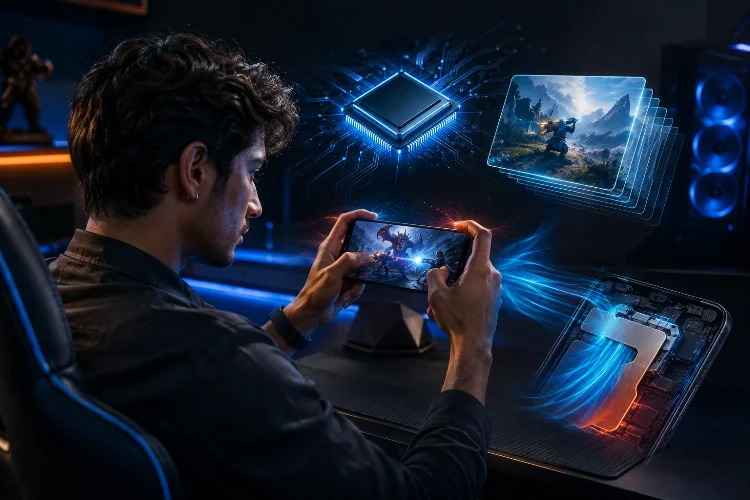
A powerful smartphone can look unbeatable on a specification sheet and still deliver disappointing gaming after twenty minutes. That happens because gaming performance is not controlled by the processor alone.
Smooth gameplay depends on how the chipset, GPU, display, cooling system, battery management and game software work together. A fast chip may generate impressive peak frame rates, but heat can eventually force the phone to slow down. A 120Hz screen can look wonderfully fluid, but only when the game and hardware can consistently produce enough frames.
Understanding Mobile Gaming Performance therefore means looking beyond benchmark numbers. If you are choosing a phone for gaming, the most important question is not simply how fast it can run, but how smoothly and consistently it performs throughout an actual gaming session.
1. The Chipset Sets the Performance Ceiling
The chipset, or system-on-chip, is the foundation of smartphone gaming performance.
Modern mobile platforms combine CPU cores, graphics processing, memory controllers and other specialised components. Qualcomm’s Snapdragon platforms, for example, use Adreno GPUs designed for graphics-intensive workloads while balancing performance and power consumption.
The CPU handles tasks such as game logic, physics and background processes, while the GPU is responsible for rendering most of the visual workload.
A stronger chipset can therefore support higher graphics settings, more complex effects and faster frame rates. However, peak processing power is only one part of the equation.
If two phones use similar high-end processors but one has significantly better cooling, their performance can become very different during longer gaming sessions.
2. GPU Performance Matters More as Graphics Become Demanding
Simple puzzle games rarely push modern GPUs very hard. Large 3D titles are different.
High-resolution textures, lighting effects, shadows, particles and complex environments place substantial pressure on the graphics processor. Technologies such as variable rate shading, hardware-accelerated ray tracing and graphics upscaling can also influence how modern games balance image quality and performance.
Qualcomm’s mobile gaming technologies, for example, include features designed to improve graphics performance while managing power consumption.
This is why gaming-focused buyers should look beyond CPU benchmark results.
A phone may have excellent general processing power but still perform differently from another device in GPU-heavy games. Real gaming tests are particularly useful because they reveal frame-rate behaviour under workloads people actually play.
3. Refresh Rate Determines What the Display Can Show
A fast processor cannot make a 60Hz display physically show 120 unique frames every second.
Refresh rate describes how frequently the screen can update its image. Android documentation notes that modern devices commonly support refresh rates such as 60Hz, 90Hz and 120Hz. Higher rates can create smoother motion, although they can also increase display power consumption.
That relationship becomes important in gaming.
If a game runs at 120 frames per second on a 120Hz display, movement and animation can appear noticeably smoother than at 60fps. Competitive games may also feel more responsive.
But the game must actually support the higher frame rate, and the chipset needs enough performance to maintain it.
A 120Hz screen therefore does not automatically guarantee 120fps gaming.
4. Stable FPS Matters More Than a High Peak Number
Imagine one phone reaches 120fps but regularly drops to 75fps. Another stays close to 90fps almost all the time.
The second phone may feel smoother despite having a lower maximum frame rate.
Android’s gaming guidance emphasises that average FPS alone cannot reveal every performance problem. A game can average 60fps while still suffering from intermittent frame drops, micro-stuttering and inconsistent input response.
This is where frame pacing becomes important.
Frame pacing refers to delivering frames at consistent intervals. Android’s Frame Pacing technology is designed to reduce uneven frame delivery and can adapt to different display refresh rates.
For gamers, this means consistency is often more valuable than a spectacular number appearing briefly in a benchmark.
5. Cooling Determines How Long Performance Can Last
Heat is one of the biggest enemies of sustained mobile gaming performance.
When the CPU and GPU operate at high power for an extended period, they generate heat. If temperatures rise too far, the system may reduce processor performance to control temperature and power consumption. This process is commonly called thermal throttling.
That is why two smartphones using the same chipset can behave differently after thirty minutes of gaming.
A device with a large vapour chamber, well-designed internal heat spreaders or other effective thermal management may maintain higher performance for longer.
Meanwhile, a thin phone with limited cooling space might begin extremely fast but gradually reduce clock speeds as temperatures increase.
For serious gamers, sustained testing is therefore more informative than a single short benchmark run.
6. Stress Tests Reveal What Happens After the Phone Gets Hot
Benchmark scores are useful, but short tests mainly measure peak performance.
Stress testing provides a different perspective.
3DMark’s Wild Life Stress Tests, for example, repeatedly run a demanding graphics workload for twenty loops to show how a mobile device manages performance and temperature during extended heavy use.
Suppose a phone begins a test with a score of 10,000 but later falls to 6,000. Another starts at 8,500 and remains close to 8,000.
The first device wins on peak performance, while the second provides stronger sustained performance.
That distinction can matter enormously if you regularly play demanding games for an hour or more.
When reading smartphone gaming reviews, look for performance stability percentages, long-duration FPS testing and temperature measurements rather than relying only on the highest benchmark score.
7. Higher Frame Rates Also Increase Power Demands
Running games faster requires more processing work.
The CPU and GPU must prepare and render frames more frequently, while a high-refresh-rate display updates more often. Android specifically warns developers that targeting higher rendering rates can increase thermal pressure and battery drain.
This creates an important trade-off.
Running a game at 120fps may look fantastic, but 60fps could offer substantially longer battery life while still feeling smooth. Some players may therefore prefer maximum performance, while others prioritise endurance.
Android’s Game Mode tools even allow games and devices to optimise around performance or battery-life priorities.
For longer sessions away from a charger, reducing frame rate or graphics settings can sometimes produce a better overall experience than simply running everything at maximum.
8. Game Optimisation Can Matter as Much as Hardware
Powerful hardware does not guarantee that every game will use it efficiently.
Developers must optimise games for different processors, GPUs, displays and thermal characteristics. Android provides tools such as the Android Dynamic Performance Framework to help games adjust workloads according to CPU, GPU and thermal conditions.
This explains why one game may run beautifully on a particular phone while another title struggles despite appearing less demanding.
Driver optimisation, game-engine settings, resolution scaling, frame pacing and software updates can all influence the result.
When choosing a gaming phone, it is therefore useful to find tests of the actual games you play rather than assuming benchmark leadership automatically translates into perfect performance everywhere.
Strong Mobile Gaming Performance comes from balance rather than one impressive specification. A powerful chipset and GPU determine what the phone can potentially achieve, while the display controls how smoothly those frames can be presented.
Cooling then determines how long that performance can be maintained before heat becomes a problem. Frame pacing, battery efficiency and game optimisation add another layer to the experience.
Before choosing your next gaming phone, look beyond headline benchmark scores. Check sustained FPS tests, temperatures, display refresh rate, cooling design and performance after longer gaming sessions. A phone that stays consistently fast for an hour can be much more enjoyable than one that wins a benchmark for five minutes.