
Wireless Earbud Features That Matter More Than Premium Branding

Premium logos can make wireless earbuds feel like the safest choice. Spend more money, choose a famous brand, and surely you will get better sound, clearer calls and stronger noise cancellation. Unfortunately, wireless audio is not quite that simple.
Some expensive earbuds are excellent, but a recognisable logo does not guarantee they will fit your ears, work perfectly with your phone or deliver the features you actually need.
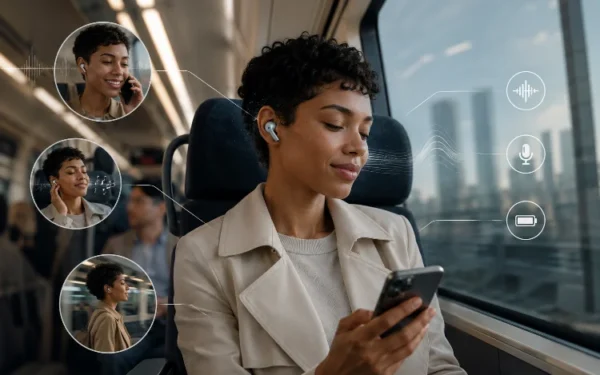
The smartest way to shop is to focus on Wireless Earbud Features that influence everyday use. Comfort, tuning, active noise cancellation, microphone performance, Bluetooth stability and battery life can matter far more than the name printed on the charging case.
Before paying extra for prestige, here is what deserves your attention.
1. Comfort and Fit Should Come Before Everything Else
You can have fantastic drivers and advanced audio processing, but none of that matters if your ears hurt after 45 minutes.
Fit also influences sound. In-ear earbuds rely on a good seal to reproduce bass effectively and isolate external noise. Apple similarly notes that the effectiveness of noise-control features on compatible AirPods Pro models depends on achieving a good fit.
Look for earbuds that include several ear-tip sizes, and do not assume the medium tips installed at the factory are automatically right for you.
Weight and shape matter too. A slightly less premium-looking pair that stays comfortble during a three-hour flight is more useful than beautiful earbuds you constantly need to adjust.
2. Good Sound Is About Tuning, Not Just Expensive Hardware
Driver size is one of the easiest specifications to market. Unfortunately, a larger driver does not automatically produce better music.
Audio tuning determines how bass, mids and treble are balanced. Some earbuds emphasise deep bass, while others focus on vocal clarity or a more neutral presentation.
Think about what you normally listen to.
Heavy bass may work brilliantly for electronic music but could overwhelm podcasts or acoustic recordings. If possible, choose earbuds with an adjustable equaliser because it gives you much more flexibility than simply trusting a manufacturer’s default sound profile.
Support for modern Bluetooth codecs can also matter. Qualcomm’s aptX Adaptive, for example, is designed to adjust according to factors such as audio requirements and wireless conditions, balancing quality, latency and connection robustness.
The important detail is compatibility: a codec provides little benefit if your phone does not support it.
3. Effective ANC Is More Valuable Than an Impressive Feature List
Active Noise Cancellation can completely change how earbuds feel on trains, buses and aeroplanes.
Instead of simply blocking sound physically, ANC uses microphones and processing to reduce external noise. The quality of implementation can vary significantly, which is why seeing “ANC” on the box tells you very little about how effective it actually is.
Transparency or ambient listening is equally important.
Apple’s implementation, for example, allows supported AirPods to switch between Active Noise Cancellation and Transparency mode, with the latter allowing surrounding sound to remain audible.
A good pair should make these modes easy to control. During a commute, being able to hear a station announcement without removing your earbuds can be more valuable than another premium audio effect you rarely use.
4. Microphone Quality Matters If You Actually Make Calls
Earbuds can sound wonderful to you while making your voice sound terrible to everyone else.
Call performance depends on microphone placement, noise reduction, wind handling and voice-processing software. Simply counting how many microphones are inside the earbuds is not enough.
Look for reviews containing real microphone recordings from quiet rooms, busy streets and windy environments.
This is particularly important for remote workers. If you take Teams, Zoom or normal phone calls several times a day, clear speech should probably rank above subtle improvements in music detail.
Call quality is one area where testing reveals a much bigger diffrence than specification sheets.
5. Bluetooth Stability Is Easy to Ignore Until It Goes Wrong
Wireless earbuds are only convenient when the wireless part works properly.
Bluetooth performance can vary according to radio design, interference, physical obstacles and the surrounding environment. The Bluetooth SIG explains that effective Bluetooth range is influenced by several technical and environmental factors rather than being one universal fixed distance.
In everyday use, reliable conection matters more than theoretical maximum range.
Your earbuds should remain stable when your phone is in a trouser pocket, inside a bag or surrounded by dozens of other wireless devices at a railway station.
Newer technologies such as Bluetooth LE Audio also introduce capabilities including LC3 audio and Multi-Stream Audio, which allows multiple synchronised audio streams between compatible devices.
Again, compatibility between your phone and earbuds matters more than simply having the newest Bluetooth number printed on the packaging.
6. Battery Life Needs to Match How You Use Earbuds
Manufacturers often advertise total battery life by combining earbud runtime with several additional charges from the case.
That number is useful, but single-charge endurance deserves equal attention.
Someone who listens for 40 minutes during a commute has very different requirements from someone who wears earbuds through an eight-hour working day.
ANC, call usage, volume and other features can also influence runtime. Apple notes, for example, that actual battery performance varies according to settings, environment and use.
Consider charging convenience as well. Quick charging can be surprisingly useful if ten minutes in the case provides enough energy for another commute.
A small, easy-to-carry case can also be more practical than chasing the largest possible battery figure.
7. Controls and Multipoint Can Improve Everyday Use
Premium sound means little if adjusting volume or answering calls is frustrating.
Good earbuds should provide quick access to playback, volume, calls and listening modes. Controls should also be deliberate enough that repositioning an earbud does not accidentally pause your music.
Apple’s supported AirPods, for example, allow users to configure controls for functions such as volume and switching between listening modes.
For people who regularly work between a smartphone and laptop, multipoint connectivity can be especially useful when available. It can reduce the friction of repeatedly disconnecting and pairing devices.
This type of feature rarely sounds exciting in advertising, but it can have a bigger impact on daily convenience than a premium finish.
8. Durability Matters More Than Luxury Materials
Earbuds live a surprisingly tough life.
They are carried in pockets, exposed to sweat, used during light rain and regularly dropped into bags. Water and sweat resistance therefore deserve attention if you exercise or commute outdoors.
Do not assume resistance lasts forever. Apple explicitly notes that water and sweat resistance on supported AirPods is not permanent and can decrease through normal wear.
Build quality also includes the charging case, hinge and charging contacts.
A glossy premium case that becomes heavily scratched after a few weeks may be less practical than a simpler but more realiable design.
The most important Wireless Earbud Features are the ones you notice every day: comfortable fit, enjoyable sound, useful ANC, clear microphones, stable Bluetooth, practical battery life and easy controls.
Before paying extra for a famous logo, compare how the earbuds perform in the situations that matter to you. A less prestigious pair that fits better and works reliably can easily become the smarter purchase.
Related Articles