Best Battery Smartphones for Heavy Users and Long Screen Time
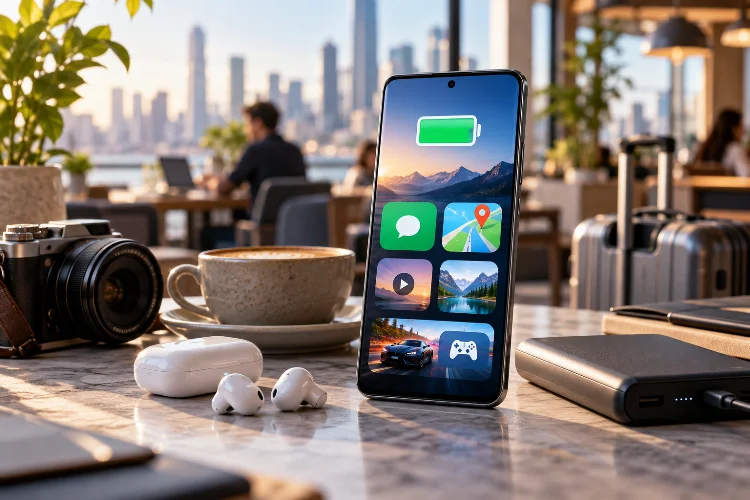
A phone that lasts until dinner is fine for casual users. But if your day includes hours of messaging, navigation, video streaming, social media, photography, gaming, and hotspot use, “all-day battery” can mean something completely different.
Heavy users need more than a large number printed next to the battery specification.
The best battery smartphones combine high-capacity cells with efficient processors, adaptive displays, smart power management, and fast charging.
New silicon-carbon battery technology is also allowing manufacturers to fit 7,000mAh-plus batteries into phones that still look and feel like normal flagships.
Real-world endurance matters just as much. A 7,500mAh phone can perform differently depending on display brightness, chipset efficiency, network conditions, software optimization, and workload.
For extended screen time, the ideal phone should remain reliable during browsing, streaming, gaming, and productivity without constantly forcing you to search for a charger.
Here are some of the strongest Android options for heavy users right now.
OnePlus 15: Best Overall Battery Flagship
The OnePlus 15 is one of the easiest recommendations for anyone putting battery life above almost everything else.
It packs a massive 7,300mAh battery while still delivering flagship-level performance through Qualcomm’s Snapdragon 8 Elite Gen 5. OnePlus also supports 120W wired SUPERVOOC and 50W wireless charging, so the phone combines long endurance with very quick refills.
Independent testing makes the specifications even more impressive.
Tom’s Guide recorded 25 hours and 13 minutes in its battery test, placing the OnePlus 15 at the top of its 2026 battery-life ranking. PhoneArena also measured more than 30 hours of browsing in its own test methodology.
That makes it especially attractive for people who spend hours watching content, browsing, traveling, or working from their phone.
The main lesson here is simple: battery capcity is not just marketing when software and hardware efficiency are strong enough to support it.
OPPO Find X9 Pro: Excellent for Streaming and Long Screen Time
The OPPO Find X9 Pro goes even bigger with a 7,500mAh silicon-carbon battery.
It supports 80W SUPERVOOC wired charging and 50W AIRVOOC wireless charging. OPPO pairs that battery with the MediaTek Dimensity 9500, making the device suitable for demanding workloads without turning it into a bulky battery-focused phone.
Its endurance results are particularly impressive for media consumption.
Notebookcheck measured approximately 34 hours and 19 minutes of Wi-Fi browsing and more than 41 hours of local 1080p video playback under its standardized testing conditions. Under maximum load, it still lasted just under five hours.
Those results make the Find X9 Pro a great fit for users who spend huge portions of the day looking at their screen.
It is especially appealing for travelers, mobile photographers, content consumers, and people who regularly use their phone instead of a tablet.
OnePlus 15R: Best Battery Value for Heavy Users
You do not necessarily need to buy the most expensive flagship to get exceptional endurance.
The OnePlus 15R uses an even larger 7,400mAh battery, paired with the Snapdragon 8 Gen 5 platform. It also supports charging up to 80W with compatible OnePlus hardware.
Tom’s Guide measured around 21 hours and 54 minutes in its battery testing, placing it behind only the OnePlus 15 in its 2026 ranking at the time of testing.
That combination makes the 15R particularly interesting for value-focused power users.
You sacrifice some premium camera and luxury features compared with top Ultra-class phones, but battery endurance remains outstanding.
For students, commuters, delivery workers, frequent travelers, or anyone who spends most of the day away from a charger, that trade-off can make a lot of sense.
ASUS ROG Phone 9 Pro: Best for Long Gaming Sessions
Gaming creates a very different type of battery stress.
A phone can last all day while browsing but drain dramatically faster when the CPU, GPU, display, speakers, and network connection are running hard at the same time.
That is where the ASUS ROG Phone 9 Pro stands out.
It uses a 5,800mAh battery with 65W charging and supports bypass charging. The latter is especially useful for gamers because external power can run the phone without constantly charging the battery, helping reduce unnecessary heat during long gaming sessions.
ASUS claims at least 4.5 hours of heavy gaming, 22.1 hours of video streaming, and 23.4 hours of social media scrolling under its test conditions.
Tom’s Guide also recorded 20 hours and 34 minutes in its browsing battery test.
For gamers, endurance is not just about lasting longer. Cooling and power management must remain consistant when the phone is under sustained load.
Samsung Galaxy S26 Ultra: Best Mainstream Premium Choice
Not everyone wants the biggest battery possible.
Some users want excellent endurance alongside premium cameras, long software support, productivity features, and broad accessory availability. The Galaxy S26 Ultra fits that role well.
Samsung sticks with a 5,000mAh battery, considerably smaller than the latest 7,000mAh-plus competitors. However, efficient hardware and software optimization help it deliver competitive endurance.
Tom’s Guide recorded 16 hours and 10 minutes in its battery test. That is significantly behind the OnePlus 15, but still strong enough for demanding all-day usage.
Samsung also upgraded wired charging to 60W. The company says the S26 Ultra can reach around 75% in approximately 30 minutes with compatible charging equipment.
The S26 Ultra therefore makes sense for users who want realiable battery life without choosing a phone primarily around battery capacity.
Why Battery Size Alone Can Be Misleading
It is tempting to compare phones simply by looking at their milliamp-hour rating.
A 7,500mAh battery should generally have an advantage over a 5,000mAh battery, but capacity does not directly tell you how many hours of screen time you will actually get.
The display can dramatically change energy consumption. High brightness, 120Hz or 165Hz refresh rates, gaming, GPS navigation, 5G connectivity, camera recording, and poor cellular signal can all increase power demand.
Chip efficiency matters too.
A processor that completes tasks using less energy can make a smaller battery perform surprisingly well. Software also decides how aggressively background applications are allowed to run.
This is why standardized testing is useful—but even test results need context. Tom’s Guide, PhoneArena, and Notebookcheck use different workloads and testing methods, so their numbers should not be compared as if they came from the same benchmark.
Look for patterns instead of one magic number.
What Heavy Users Should Prioritize
For extended screen time, battery capacity is only the starting point.
A heavy user should also consider charging speed, display efficiency, thermal management, software optimization, and how the phone performs under sustained workloads.
For someone who mainly watches videos and browses, the OPPO Find X9 Pro or OnePlus 15 offers exceptional endurance. Gamers may benefit more from the ROG Phone 9 Pro because features such as bypass charging can matter during several hours of continuous play.
The OnePlus 15R provides a compelling middle ground for users who want endurance without flagship pricing.
Meanwhile, Samsung’s Galaxy S26 Ultra remains attractive when battery life needs to coexist with a more complete premium feature set.
Your workload matters more than chasing the largest battery specification available.
The best battery smartphones for heavy users are increasingly capable of going far beyond a traditional single day of moderate use.
The OnePlus 15 currently stands out for overall endurance, while the OPPO Find X9 Pro combines its huge 7,500mAh battery with excellent browsing and video results.
The OnePlus 15R delivers strong value, the ROG Phone 9 Pro remains an excellent gaming-focused option, and Samsung’s Galaxy S26 Ultra provides solid battery life inside a polished mainstream flagship.
Before buying, compare more than mAh. Look at independent endurance tests, charging speed, display efficiency, thermal behavior, and your own usage pattern.
If screen time is one of your biggest priorities, choosing the right battery-focused phone can mean leaving the power bank at home – and spending a lot less time watching that battery percentage.